India has rejected Pakistan's claims that it has arrested an "Indian spy" in the restive Balochistan province.
Pakistani authorities on Tuesday released a video in which the man is shown confessing that he was involved in spying activities. "There can be no clearer evidence of Indian interference in Pakistan," army spokesman Lt-Gen Asim Bajwa said. Delhi said the man was an Indian national, but dismissed spying charges and said he was "clearly tutored". "Government categorically rejects allegations that this individual was involved in subversive activities in Pakistan at our behest," India's foreign ministry spokesperson Vikas Swarup said in a statement to media. Mr Swarup added that India was "concerned" about the arrested man's well-being and added that "it is also relevant to note here that despite our request, we have not been given consular access to an Indian national under detention in a foreign country, as is the accepted international practice". Pakistan officials have said the man was a serving Indian navy officer and was trying to "sponsor terrorism" in Balochistan. "If an intelligence or an armed forces officer of this rank is arrested in another country, it is a big achievement," Lt-Gen Mr Bajwa said.
China Air Quality Study Has Good News and Bad News BEIJING — You’re moving to China with your family, and you’re excited but also concerned: What might the country’s notorious smog do to your and your children’s lungs? Here’s how you can feel the fear and move to China anyway, while minimizing your health risks: Relocate to Guangzhou, the capital of the southern province of Guangdong, near Hong Kong. Second best: move to Shanghai. Don’t move to Beijing, Chengdu or Shenyang, if you can help it. Those are some conclusions to be drawn from a new study of air quality in five major cities by a team of researchers at Peking University led by Chen Songxi, a statistician at the university’s Guanghua School of Management. In an interview, Mr. Chen said the study was prompted by a sense of “disgust” at air pollution. “I felt that as scientists we should do something about the situation facing a billion Chinese people,” he said. There was both good and bad news in the report, titled “Air Quality Assessment Report (2): A Statistical Analysis of Air Pollution in Five Chinese Cities” and published online. The team scrutinized three years of air quality data for the measure known as PM 2.5, the fine particulate matter that is especially hazardous to health. One source of the data was the Chinese Ministry of Environmental Protection. The other was the United States Embassy in Beijing and consulates in Guangzhou, Shanghai, Chengdu and Shenyang. By using two independent data sets, the researchers answered a second question: Is the Chinese government’s air quality data trustworthy? The answer: Yes, at least in these five cities. That was one piece of good news. China began releasing PM 2.5 figures for hundreds of locations in 2013, five years after the United States Embassy began publishing readings from monitors on its grounds that drew wide attention among Chinese. Suspicions linger to this day about the reliability of the Chinese government data. Another piece of good news: PM 2.5 levels declined over the last three years in all five cities. In Beijing, they fell from 99 micrograms per cubic meter to 81, and in Shanghai from 61 to 50. In Guangzhou, they fell from 54 to 39. That was because of two factors: stricter emissions regulations that took effect on Jan. 1, 2015, and a slowing economy. “The economic downturn helped,” Mr. Chen said. But there was bad news, too. In all five cities, the air pollution readings remained higher than the World Health Organization’s upper safety limit of 35 micrograms of PM 2.5 per cubic meter. China uses a considerably more liberal standard, classifying up to 75 micrograms as “good.” Many readings regularly exceeded that. The researchers defined a level of under 35 as “good,” and under 75 as “light” pollution, and found that Guangzhou and Shanghai had the most “good” or “light” days. About 80 percent of days each year fell into those categories. Chengdu and Shenyang had about 60 percent. Beijing came last with 50 percent. In addition, Beijing and Chengdu suffered the most prolonged spells of heavy pollution, which the team defined as readings of 150 or higher. Even Shanghai and Guangzhou did not have more than 37 percent “good” air days. “This shows the grave challenge facing China in its air pollution prevention efforts,” the report says. Mr. Chen’s interest was ignited after a colleague in the United States sent him the United States Embassy air quality readings in 2013. “The more I looked at it, the more disgusted I felt,” Mr. Chen said. “Then, on a very polluted day in early March” of 2014, “I said, ‘I have to do something.’ I called together a team.” To test the accuracy of the Chinese government data, the researchers used readings from two or three ministry monitors in each city as close as possible to the American sites. They found a “high” similarity, the report says. Photo Beijing last December during a period of heavy smog. It remains China’s worst city for air pollution, researchers found. CreditReuters “They show a lot of consistency,” Mr. Chen said. “They won’t be exactly the same, because of data randomness and because they’re not at exactly the same locations.” “If they were still manipulating the data, that would be really hopeless and I’d leave China,’’ he said. “But it does show that the government and the Ministry of Environmental Protection are serious.” Still, there were significant data problems on the Chinese side, he said. The Ministry of Environmental Protection website gives hourly readings, “but it doesn’t provide historical data,’’ Mr. Chen said. “You have to grab it, hour by hour. The government wants to do something about this, but not 100 percent.” The report recommends improving data collection and publication. The team also factored in meteorological factors and consumption of coal, petroleum and diesel to get a better picture of the relations among emissions, weather and pollution. But here too they encountered a lack of information. “The economic and energy data are very sparse,’’ Mr. Chen said. “We couldn’t find data on consumption, especially of petroleum products. We don’t know how much gasoline was sold in 2014, and we think petroleum products may be a bigger problem than coal in Beijing.” Asked where a family moving to China should settle to minimize exposure to polluted air, Mr. Chen said, “I grew up in Beijing and I love Beijing, so you put me in a very hard position.” The North China Plain, where Beijing is, and the Sichuan Basin, where Chengdu is, “are not good places to be. They’re not suitable for heavy industry,’’ Mr. Chen said. Their physical settings trap pollutants. “If you have heavy industry there, this is what you’ll get.” “Shanghai and Guangzhou are more fortunate,’’ he said, “because they’re close to the sea and have more rainfall.” Beijing’s saving grace: a strong northwesterly wind in winter that helps clear the air. But that doesn’t address the source of the problem. Another recommendation: reduce emissions.
From Senegal to Libya - an African student joins Islamic State When Sadio Gassama decided to go into medicine, he started by giving free check-ups at his mosque in Senegal's poor southern region of Casamance. Now, the 25-year-old medical student says he is treating Islamic State fighters in Libya. Until recently, many thought the peaceful, tolerant Sufi brotherhoods in countries such as Senegal could prevent more conservative and radical versions of Islam from taking hold in poorer parts of West Africa, like Mali and Niger. But security experts say Gassama's story shows how the penetration of hardline Islamic Salafism, coupled with Gulf money and militant propaganda, is aiding recruitment, even from stable and democratic Senegal. In particular, in their appeals to Africans, Islamic State propagandists are calling on doctors to make "hijrah", or pilgrimage, to their African stronghold of Sirte in Libya. Pictures posted on Gassama's Facebook page before he joined Islamic State show him hugging his young niece. Now, he is brandishing a machine gun, his name stitched on to his military uniform. Friends and family say Gassama's decision to join thousands of militants in Libya in December during the fifth year of his medical studies was sudden and unexpected. His shocked father described him as a 'humanist' motivated by a desire to help others. A former professor called him a "brilliant student, incapable of hurting anyone". But an interview with Gassama showed a darker side. Speaking from Sirte, he said he had been planning an attack in Dakar. "Senegal is lucky. I was planning to commit an attack there in the name of the Islamic State before one of their contacts helped me go to Libya," he told Reuters last month via the internet. He could not be reached subsequently. Friends said he took trucks to Libya via Mali and Niger, accompanied by another Senegalese man and paying his way with his student grant. "I left Senegal a year after embracing the ideology of the Islamic State," Gassama said. "Joining ISIS in Libya was relatively easy and accessible. I wanted to contribute to the establishment of a caliphate in Libya." Asked what he was doing there, he replied: "I am a jihadist doctor." Islamic State propaganda and security sources confirm fighters from countries including Chad, Ghana, Senegal and Nigeria are already in Libya, where the group is consolidating its presence. The number of sub-Saharan Africans is not known but they are thought to represent a minority of the 3,000-6,000 Islamic State fighters there, with most from North Africa and the Middle East. However, there are concerns more will travel there along the same desert routes migrants use to reach Europe, as Gassama did. "Libya is closer and easier to reach for some African fighters than Syria, and the political disarray there opens space for fighters to enter and operate," said Andrew Lebovich, a visiting fellow with the European Council on Foreign Relations who focuses on North Africa and the Sahel. GULF DONATIONS Across Africa's arid Sahel region, Western diplomats note an increase in conservatism, alongside tens of millions of dollars a year in charity donations from Gulf states. In Niger, some religious leaders are calling for a "re-Islamisation" against the secularism imposed by former colonial power France. This is already underway in the capital, Niamey, where some women wear the full veil and pay higher fares to avoid sharing taxis with men. Gulf-financed bodies deny links to radical groups and say their money is for charity, but local sources say it can go astray. "Contributions are intended for the poor and to build mosques but are often diverted in the wrong direction," said Bakary Sambe, director of the Timbuktu Institute and a coordinator for the Observatory on Religious Radicalism and Conflicts in Africa. This foreign money and the migration of Senegal's youth to the cities has undermined the country's Mouride brotherhood, an old-established Islamic Sufi order which preaches tolerance. In Gassama's home town of Ziguinchor, the mosque he attended in the HLM neighbourhood is funded by a Kuwaiti NGO called Africa Muslims Agency. AMA director Almany Badji said it was one of more than 100 mosques it has financed in Casamance. The mosque Gassama attended at Dakar's Cheikh Anta Diop University also has Salafist leanings, Sambe said. Gassama did not say who helped him join Islamic State more than a year ago, referring only to 'guidance' in Senegal. "Through meetings with local scholars it became clear that jihad was my Muslim duty," he told Reuters. His friends and family said the only change they noticed before he left was to a more Salafist dress code. "His pants were shorter and did not reach all the way to the floor," said his father, Boucar Gassama, a retired civil servant, surrounded by Gassama's siblings in the shady courtyard of his house. "But I could not know he had been radicalised." CALLS FOR REFORM There is growing concern in West Africa about recruitment into Islamic State and other militant groups after attacks in Mali, Burkina Faso and Ivory Coast. Modou Faye, Gassama's professor, says students need more guidance in reading the Koran, which is often rote-learnt at religious schools similar to one Gassama attended. Mauritania has closed several Koranic schools for security reasons, officials said. In Mali, where an Islamist insurgency is intensifying, some are calling for checks on mosques and NGOs. "We must take stock of the potential risks of collusion between civil society and terrorists, better monitor places where radicalisation occurs, keep tabs on all suspect individuals like radical preachers and trace their funds," former Prime Minister Moussa Mara said. But others say labelling peaceful Islamic groups as jihadists is risky. Depriving poor communities of services such as orphanages and free study trips to Saudi Arabia could provoke a backlash. "A politician who attempts to regulate this risks losing his electorate," said Moulaye Hassane, researcher at the Institute of Research and Human Sciences and Niger's former ambassador to Saudi Arabia. "I think they are afraid."
Woman celebrated Easter Mass before trying to swim to cruise ship
By Hannah Tooley A 65-year-old woman that jumped into the sea to swim to her cruise ship after it left without her, had attended an Easter mass just moments before. Susan Brown marked Mass on the island of Madeira before jumping into the Atlantic ocean to try to reach the cruise ship, the Marco Polo. Another worshipper said that she had joined in the singing and praise at Sao Pedro Church and celebrating Holy Eucharist. The woman's handbag acted as a buoyancy aid during the time she was stranded 1,600ft out at sea. According to The Telegraph the timing of the church service does not match the events recalled by Susan Brown who appeared "very confused" when she got back to land. She is a regular church-goer in her home village in Dorset, Fontmell Magna and a source told the paper she was being treated in a psychiatric unit. Susan Brown's husband - who she thought to be on the cruise ship when it left without her, is expected to arrive soon, according to the source. The 69-year-old, Michael Brown is believed to have flown home from Madeira alone. It has been reported that the pair cut short their 32 day cruise after parting company. Susan Brown was rescued by local fishermen, one said: "She seemed very pale and perturbed... It seemed her bag acted as a buoy. "She had been in the water for hours and was very confused and pale, like a survivor from the Titanic film."
Hamas tunnelling again in Gaza as Israelis fear attack from below
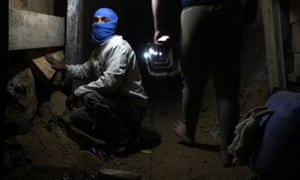
The scraping, scratching, grating sound could be an insect in the wall, a rodent under the floorboards, or the creaking of water pipes. Or it could be Hamas operatives digging under the earth from Gaza to Israel.
Some residents of the small communities along the Israeli side of the Gaza border believe they can hear the faint sound of tunnelling in the dead of night. Others are sceptical, saying fear and paranoia are fuelling imaginations.
But there is no doubt that, 19 months after the end of the last war between Israel and Gaza, in which the discovery of Hamas’s tunnels was declared a casus belli by Israel, large-scale digging has resumed.
Ismail Haniyeh, the Hamas leader in Gaza, has said so. This year he told the people of Gaza that Hamas fighters were “digging twice as much as the number of tunnels dug in Vietnam”.
The Israeli military has also said so. “We can see Hamas digging from our [observation] posts. They aren’t trying to hide it from us,” a senior Israel Defence Forces official told the Guardian.
All reports and recordings of sounds heard by residents in the communities along the border with Gaza were investigated, he said. “We take every report from citizens and soldiers very seriously.”
But, he added: “As of today, we don’t know of any tunnels that have crossed the border into Israel.”
During the 50-day war in the summer of 2014, the extent and sophistication of Hamas’s underground network took Israel’s political and military leadership by surprise.
By the time a ceasefire held, the IDF said it had destroyed 32 tunnels that crossed under the border. It declared it had achieved the strategic goal of the conflict – but some were sceptical.
Brigadier-General Shimon Daniel, former head of the IDF’s combat engineering corps, said at the time: “Of course Hamas will try to rebuild the tunnels. The moment we go out [of Gaza] they will begin to dig.”
Since the war – in which the UN estimates Israeli forces destroyed or damaged nearly 100,000 homes – almost 3.5m tonnes of construction materials have entered Gaza through the Israeli-controlled Kerem Shalom border crossing,according to Israeli figures.
Israel says Hamas has diverted much of that from house-building to tunnel construction, assisted by a flourishing black market.
Last December, Hamas’s military wing, the Qassam Brigades, formed a special unit to dig and equip tunnels and train fighters to use them. Based on the cycle of conflict over the past 10 years, they are preparing for another war.
At least five tunnels have collapsed so far this year, killing 12 members of the Qassam Brigades and injuring dozens more. In one incident, seven people were killed east of Gaza City.
According to Gazan political analyst Mustafa Ibrahim, the Qassam Brigades are “using tunnels as a strategic weapon and intend to develop them and use them extensively”. In the 2014 war, Hamas believed it caused the IDF “substantial damage” by using its underground passages to carry out operations, he added.
The Islamic militant organisation has been engaged in tunnelling activity for at least a decade. IDF soldier Gilad Shalit was captured on the Israeli side of the border in a tunnels operation in 2006, and was held in Gaza for more than five years before being released in exchanged for 1,027 Palestinian prisoners.
These days, the tunnels fall into four categories. Some are intended to snake under the border, to be used for attacks on troops or civilians. Some are for holding rockets ready to be launched through the air from Gaza to Israel.
Many form part of a labyrinth of passages and bunkers beneath Gaza City, in which Hamas leaders and senior fighters can shield themselves in periods of intense conflict.
And a few are intended for smuggling arms from Egypt into Gaza, although the Egyptian army has destroyed most of the hundreds of tunnels which existed in the black market’s heyday.
The Qassam Brigades declined a Guardian request for an interview, but last month a military leader going by the name of Abu Hamza told the Hamas-linked al-Khaleej Online: “In any future confrontation, Israelis will be surprised by the strength and solidity of these tunnels, which can withstand Israeli shelling and concussion bombs fired by the Israeli aircraft or tanks.”
The tunnels, he said, could be used to “launch a large number of advanced rockets and mortar shells toward the Israeli towns adjacent to Gaza Strip, keep fighters away from Israeli radar, help them escape any Israeli attack and hide quickly when abducting Israeli soldiers.”
The IDF military chief of staff, Gadi Eizenkot, said this year that the tunnels were “at the top of the Israel Defence Forces’ priority list”.
The United States has provided $40m (£28m) this year “to establish anti-tunnel capabilities to detect, map and neutralise underground tunnels that threaten the US or Israel,” according to a report in Foreign Policy quoting US defence department spokesman Christopher Sherwood. There is talk of an underground “Iron Dome” to match Israel’s vaunted anti-rocket defence system.
Hamas has claimed that it has found sensors and cameras at the site of tunnel collapses, fuelling rumours in Gaza that such incidents are triggered by Israel rather than engineering miscalculations by Hamas.
The IDF refused to be drawn on such claims. “We are engaged in increased engineering work along the fence between Gaza and Israel. We are doing everything in our power to take out this specific weapon,” was all the senior IDF official would say.
He was at pains to point out the IDF’s successes. “In the last war, in 50 days we destroyed tunnels that took them years to build,” he said. And he added: “On any measure, the past year and a half since the last operation has been the quietest period we have seen for a long time.”
Not all Israelis living in small agricultural communities close to the Gaza border are reassured.
“There is fear and anxiety in the air,” said Arnon Avni, a graphic designer who has lived in Kibbutz Nirim, home to 360 people and about 2km from the border, all his life. “Everyone has some level of anxiety, but it’s different from person to person.
“This is partly a psychological war. Hamas is trying to frighten us – and they succeed. If you shake the stability of people’s minds, you are doing your work.”
Avni, who is firmly on the left of the Israeli political spectrum, described a recurring dream in which Hamas fighters advance on the kibbutz and he is powerless to protect his family and community.
“This is my nightmare. But my rational fear is that another round of war is coming.”
In Netiv HaAsara, a community so close to northern Gaza that you can clearly see into Palestinian neighbourhoods such as Beit Hanoun and Beit Lahia, tomato-grower Shaike Shaked reported increased military activity on both sides of the border in recent months.
“We need a break from wars, a rest. But the way things are going, it’s just a matter of time. If there is an infiltration, and they kill civilians in Israel, what happened in the last war is tiny compared to what would happen in this event,” he said.
“Personally, I don’t want to watch the reaction from Israel. The pictures [from inside Gaza] in the last war were so cruel that I don’t want to see another confrontation.”
Photos show damage inside Brussels airport terminal after bombing35 people were killed and at least 270 were injured in bomb attacks at the Belgian capital’s Zaventem airport and Maelbeek Metro station. It is thought that three of the perpetrators – brothers Ibrahim and Khalid El Bakraoui and Najim Laachraoui – died in the explosions. Now a new set of photographs made available by Reuters to the Belgian daily Het Nieuwsblad shows the extent of the damage inside the departure terminal where two bombs went off at Zaventem. The sole suspect charged over last week’s Brussels attacks, Faycal C., was released earlier this week due to a lack of evidence linking him to the carnage, Belgian prosecutors said. (Picture: REUTERS)(Picture: REUTERS)(Picture: REUTERS)Belgian media had identified the man as Faycal Cheffou who claimed to be a freelance journalist. Cheffou was charged on Saturday with ‘taking part in a terrorist group, terrorist murder and attempted terrorist murder.’ (Picture: REUTERS)(Picture: REUTERS)(Picture: REUTERS)(Picture: REUTERS)Earlier this week, the Belgian health minister, Maggie De Block, wrote on Twitter that ‘medical teams did all possible’ to save four people injured in last Tuesday’s attacks, but that they had died in hospital, which takes the death toll to 35. On the same day, new footage was released of the third airport suspect, dubbed ‘the man in white’. Belgian prosecutors had charged three more people had been charged with terrorist activity. (Picture: REUTERS)(Picture: REUTERS)(Picture: REUTERS)
Central Banks Warm To Collective Bargaining Something peculiar is happening. Up until recently, many central bankers were looking at robust collective bargaining and wage formation systems as a possible source for inflationary wage developments. Indeed, central banks, and the ECB in particular, have on numerous occasions called for more flexible and decentralised (read: weakened) wage bargaining systems so as to remove any inflationary threat to price stability targets coming from hikes in wages. Currently however, we seem to be observing something of a change in their thinking. This is most obvious in Japan but also noticeable in the UK and even popping up in some of the thinking of ECB policy makers. Japan: Lessons From 15 Year Deflation Let’s start with Japan which, traumatised as it is by 15 years of deflation, has been leading the way here. As long as two years ago, at the Summer 2014 Jackson Hole conference where Mario Draghi announced for the first time the (overdue) coming of quantitative easing to the Euro Area, the governor of the Japanese Central Bank, Haruhiko Kuroda, testified to the vicious interaction that took place in Japan between falling prices and falling wages. Hit by an initial negative demand shock (the bursting of the asset price bubble), business turned the squeeze on wages by, amongst other things, refusing to participate any longer in coordinated wage bargaining rounds (the so called Spring offensive) and resorting instead to company based wage bargaining where employers are able to extract substantially more concessions from workers.. Whereas this type of bargaining certainly boosted profit margins (but not business investments!), it also pushed Japan into a situation whereby falling wages and falling prices have been chasing each other over the past decade and a half. In the same speech, Kuroda is also making a point that is crucial for the discussion in the Euro Area (see below): Strengthening wage-formation institutions is crucial in raising inflation expectations. If economic agents realise trade unions are willing and able to raise nominal wages by at least 2 or 3% a year, then they will also change their expectations about inflation. And, as we know from the monetarist counterrevolution, if inflation expectations change then so will inflation itself as every actor will start basing its pricing decisions on these changed and higher expectations. This point is further rammed through in an article where one of the co-authors is no less than the IMF’s ex-chief economist, Olivier Blanchard. The authors of that article are actually calling upon the government of Japan to, as they call it, ‘force the issue’ and to ‘jump-start’ a wage-price spiral by requiring an annual wage indexation of at least 3% in a coordinated, tripartite collective bargaining round and to delay the promised cuts in corporate taxes until companies raise wages across Japan. Unease At The Bank Of England Shifting from Japan to the UK, Andrew Haldane, chief economist of the Bank of England, observes in a speechgiven to the TUC in November 2015 that the Bank has systematically over estimated the path of wages when deciding on monetary policy over the recent years. Wages in the UK have lagged behind productivity for several years and the labour share of income has been falling. The problem Haldane alludes to in his speech is that the Bank of England is counting on a clear acceleration of wage growth when making its current economic forecasts. The assumption used in the Bank’s forecasts is that wages in coming years would actually grow faster than productivity so as to enable the labour share of income to catch up the losses it suffered over the recent past. If that were not to happen, if pay growth did not experience any lift-off, the Bank’s chief economist warns of a substantial undershooting of the price stability target over the next two years. A Novelty: Is The ECB Becoming Concerned About Low Wage Dynamics? Even at the ECB, where some of the staunchest opponents of robust collective bargaining institutions can be found, the mind-set seems to be changing somewhat, although this change of mind is only half-hearted. Take the speech Draghi made at the start of this month that was reported in the Financial Times of 1 February and where he confirmed that the danger of ‘second-round’ effects was indeed occurring. We quote: “While the most recent wave of disinflation is mainly due to the renewed sharp fall in oil prices, weaker than anticipated growth in wages together with declining inflation expectations call for careful analysis of the channels by which surprises to realised inflation may influence future price and wage setting in our economy”. In other words, Draghi is referring to the same mechanism we described above which is that inflation expectations matter quite a lot. If the collapse in oil prices brings headline inflation down to close to zero and if expectations about future inflation react and follow this downward trend, then low inflation is no longer a temporary but a permanent phenomenon as it becomes entrenched in actual price and wage setting behaviour. This is indeed what is currently happening in the euro area and explains Draghi’s concerns. Longer term euro area inflation expectations (as expressed in 10 year swaps) are, at around 1.2%, way below the ECB’s price stability of ‘below but close to 2%’. At the same time, recent euro area nominal wage growth has declined further and is now limited to just 1% with nominal unit wage costs even diving below 1%. Everything is of course connected since, on the one hand, such weak wage cost developments feed into corporate decisions not to (or hardly) increase prices which then cements extremely low inflation expectations. The ECB clearly has a downward wage-price spiral on its hands, a spiral putting at risk the euro area’s price stability target and entrenching the situation of close to zero inflation. Coordinated Collective Bargaining: One Of The ECB’s Best Friends In The Fight Against Price Instability If policy makers at the ECB now seem to be aware of this problem, they keep struggling with what to do about it. Basically, Draghi’s strategy to break this self-fulfilling spiral is to “talk up” inflation expectations by loudly announcing that the ECB will print and inject even more money than before into the economy. The hope is that economic agents will perceive this as a credible signal and will start incorporating higher inflation expectations in their wage and price setting. Trade unions, expecting a recovery in inflation to, let’s say, 2% would then immediately scale up nominal wage demands. Business management from their side will not fight ‘tooth and nail’ against such wage higher demands. As business will be expecting all prices, including the prices of products from their competitors, to go up by 2%, they will consider it feasible to translate the higher wage demands of trade unions into higher prices. The miracle of self-fulfilling expectations would be once again at work but this time in the positive sense. In the textbook of monetary economics, putting the money printing press into higher gear is enough to ensure the credibility of the central bank’s commitment to higher inflation expectations. However, in today’s economy of high debt, rising inequalities and banking systems plagued by non-performing loans, it is extremely unlikely that just printing more money is sufficient to get the economy moving again, hence to raise inflation expectations. Indeed, experience thus far with the ECB’s policy of quantitative easing is unconvincing. Despite having added an extra €500bn to the euro area’s money stock since the beginning of 2015, euro area growth performance or inflation numbers have not substantially improved. Recently, in November 2015 and January 2016, inflation expectations have even been falling at the very moment the ECB was announcing its intention for further monetary policy easing (see here). In other words, to put a halt to the downwards slide into deflation and to get the economy back to price stability, the ECB should do more than give speeches. The ECB’s commitment to reaching a reasonable inflation rate needs to be backed up by delivering concrete and convincing action, action that is going beyond the act of simply printing more money that tends to end up in the balance sheets of banks and institutional investors but not in tangible demand in the real economy. One powerful way to do this, as Japanese policy makers have come to realise, involves the process of collective bargaining. By preventing too low inflation from spilling over into extremely low wage increases, collective bargaining is able to function as a circuit breaker in this process of lower wages chasing lower prices. This has two important implications for the ECB. The first is that the ECB has to dump its crusade to have ultra-wage flexibility by decentralising bargaining to a strict company-by-company basis. Such atomised bargaining is very difficult to coordinate. Indeed, it is almost impossible to expect of company level bargainers (both management as well worker representatives) that they depart from the individual company level point of view and regard low inflation as a serious problem and not as an opportunity for the individual company to become more competitive and save jobs while leaving the responsibility for the stabilisation of the wider economy to the others. This failure of coordination of company level agreements inevitably leads to the outcome the ECB is seeking to avoid: Low inflation becoming entrenched by extremely weak wage deals. Calls from European central bankers to accelerate structural reforms, in particular when these concern deregulation of collective bargaining institutions are therefore highly counterproductive. How can one expect robust wage deals if at the same time the balance of power continues to be shifted by these reforms from labour to capital? Policy advice arguing in favour of an immediate 5% cut to unit wage costs in Spain and Italy, such as the one given here is simply perverse. If such advice were to be pursued, it would intensify the process of disinflation and result in real deflation. Stopping doing the wrong things will avoid making matters worse. It is also important to start doing things that solve the problem. What the ECB could do here is to mobilise collective bargaining and wage formation institutions, not as it used to do with the intent of squeezing wages, but with the aim of keeping wage dynamics up in the face of low and falling inflation expectations. Besides issuing a general call on the need to have robust wages, the ECB should make it perfectly clear it has completely reconsidered its view on decentralised bargaining and is now stressing the value of “coordination” of collective bargaining as such coordination makes it possible to align wage bargaining rounds with the macro needs of the economy such as the need to prevent low inflation or even deflation from becoming entrenched. To convince economic agents of the seriousness of its change in mind, the ECB could openly and publicly reach out to social partners across the euro area. Where coordinated systems of collective bargaining exist, the ECB’s message would be to insist on social partners using coordination of bargaining as a way to break the ongoing spiral of disinflation. Where such systems do not exist (and in several cases, such systems have been destroyed by the policy of internal wage devaluation), the ECB could suggest reintroducing a degree of coordination in the institutional framework. All of this may sound pretty utopic. One should however keep in mind that the conventional policies of austerity and internal wage devaluation have failed and have brought us to a situation where the unconventional action proposed above is the only effective way out. Let’s hope policy makers in and outside the ECB will soon come to realise this.